
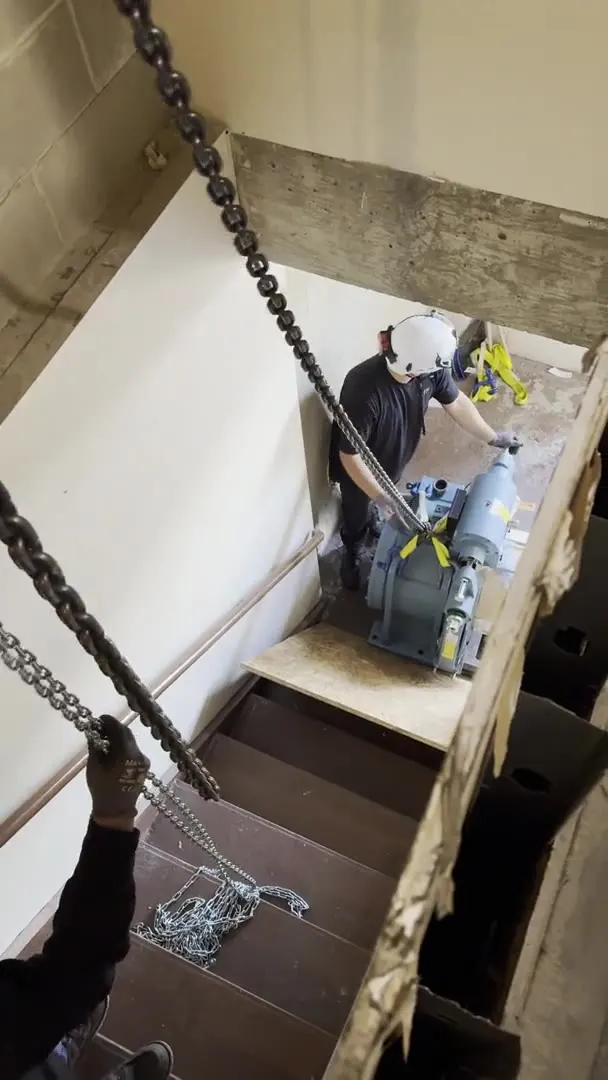
NYC Outage Rules
NYC Elevator Out of Service: How Long Can a Landlord Leave It Broken?
NYC elevator outage rules: the 14-day alternative accommodation rule, the notices owners must post, when HPD steps in, and what to do on day one.
It’s 7am, the super is on the phone, and the only elevator in a six-story walk-up conversion is stuck at the lobby with the doors open and an out-of-service sign taped to them. By 9 the managing agent’s inbox has a dozen emails from residents, and one of them asks the question we hear more than any other: how long is the landlord actually allowed to leave it like this?
The honest answer is that New York City doesn’t give you one magic number for every outage. It gives you a set of clocks. The big one changed this year. Since June 11, 2026, a building with every elevator out for more than 14 days has to offer tenants alternative accommodations and show DOB why it’s taking so long. Here’s how those clocks work and what to do the morning the car goes down.
- Outage that triggers alternatives
- 14+ days
- NYC 311 elevator complaints, 2025
- 23,066
- Buildings referred to HPD, FY25
- 176
- Avg days, referral to fix
- 56
311 count: NYC Open Data, 311 Service Requests, elevator complaint types to DOB and HPD, data updated October 25, 2026. HPD figures: Local Law 101 report, FY25 (July 2024 to June 2025).
The short answer
If one car out of three is down, the building still has service, and the rules below mostly don’t kick in. The pressure comes when every elevator serving the building, or a section of it, is out. That’s the situation 1 RCNY §103-19 is written for.
DOB moved this rule into its current home when it rewrote the old Chapter 11 elevator rules. The new section took effect on June 11, 2026, and it added the 14-day alternative accommodation requirement that wasn’t in the old version. If you’re working from a checklist your office wrote a few years ago, it’s out of date.
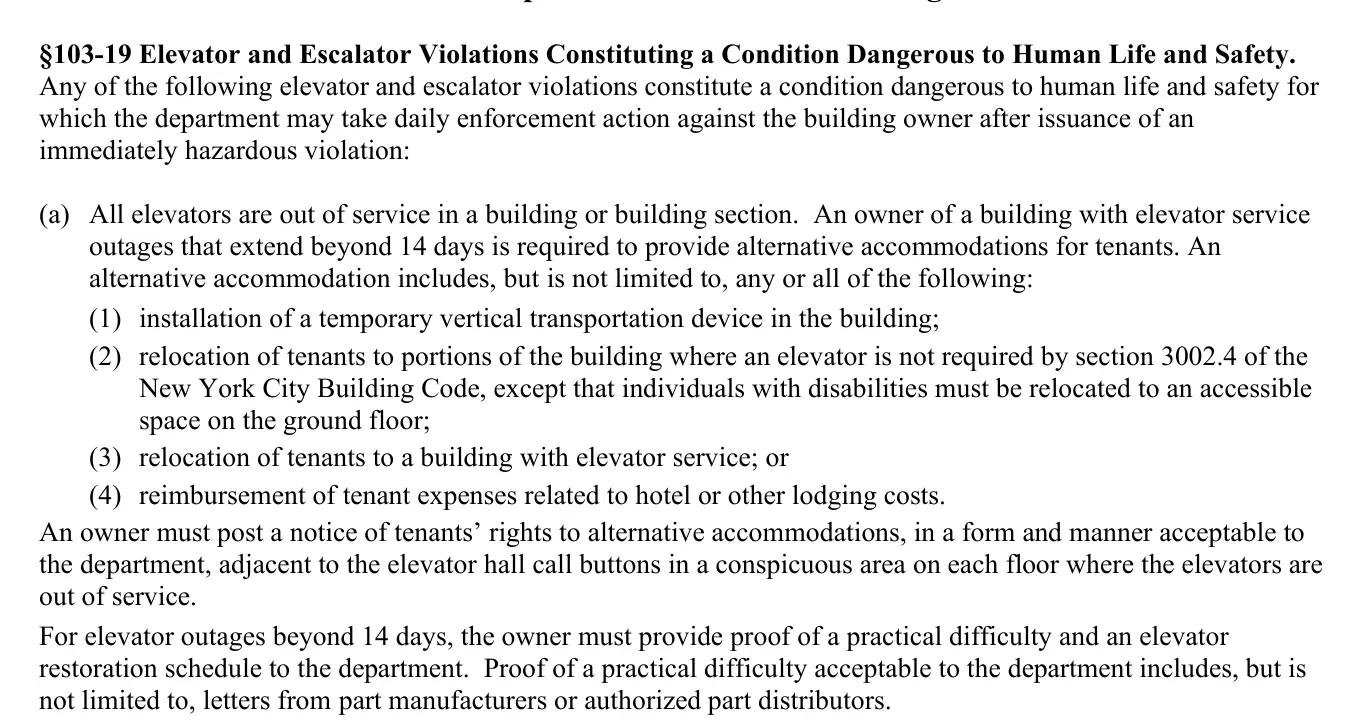
Subdivision (a) of the rule. The rest of §103-19 lists the other defects DOB treats the same way, such as defective door interlocks, brakes and car safeties.
Source: 1 RCNY §103-19 (PDF), NYC Department of Buildings. Captured October 21, 2026.So, can a landlord leave a building’s only elevator broken for a month? Legally, the owner has to be working the problem the whole time, and after day 14 the obligations get a lot heavier. Practically, the owner who waits until day 14 to start the paperwork is going to have a bad week.
What the 14-day rule asks of an owner
Once an outage of all elevators passes 14 days, the rule asks for three things.
Alternative accommodations for tenants. The rule gives four examples and says the list isn’t exhaustive: a temporary vertical transportation device in the building, moving tenants to floors where an elevator isn’t required by Building Code §3002.4 (people with disabilities go to an accessible ground-floor space), moving tenants to a building with elevator service, or reimbursing hotel and other lodging costs.
A posted notice of tenants’ rights. It goes next to the hall call buttons, somewhere people will see it, on every floor where the elevators are out. DOB decides the acceptable form, so check with DOB before you design your own.
Proof of a practical difficulty and a restoration schedule, sent to DOB. The rule’s example of proof is a letter from the parts manufacturer or an authorized distributor. In real life that’s the lead time letter for a controller board, a hoist motor rewind, or a set of door operators that have to be built to order.
The notices you have to post, even on day one
Local Law 47 of 2015 (Administrative Code §28-304.10) covers notice in R-1 and R-2 buildings, which is most apartment buildings, co-ops and condos. Notices go up in English and Spanish and say what work is being done and the expected start and end dates.
| Situation | Notice required |
|---|---|
| Elevator out for alteration work, such as a modernization | At least 10 business days before work starts. Emergency repairs, minor alterations and ordinary repairs are excluded. |
| All elevators in a building or section out for two hours or more (planned) | At least 24 hours before the work starts. |
| All elevators out from emergency work, and it runs two hours or more | As soon as practicable after the outage begins. |
| All elevators out for under two hours | Not required. |
| All elevators out more than 14 days | Notice of tenants' rights to alternative accommodations at the hall call buttons on each affected floor (1 RCNY §103-19). |
Sources: Local Law 47 of 2015 and 1 RCNY §103-19.
The emergency row is the one people forget. A breakdown at 7am isn’t planned, so there’s no 24-hour notice, but once it’s clear the car will be out two hours or more, the sign should go up. Keep a blank bilingual template in the super’s office so nobody is writing one by hand in the lobby.
When DOB hands the building to HPD
If an owner doesn’t restore service as DOB ordered and the compliance period runs out, DOB refers the condition to the Department of Housing Preservation and Development. That referral process has been in place since July 1, 2016 under Local Law 101 of 2015.
HPD looks at why the elevator is down and whether there’s another working car. It can hire its own contractor, and the bill goes to the property through the Department of Finance. Unpaid, it becomes a tax lien that carries interest. HPD can also go to Housing Court for an order. HPD’s own page warns that city contracting and wage rules can make that work “significantly more expensive” than what the owner could have arranged.
The city publishes the referral numbers every year. For fiscal year 2025:
| Fiscal year 2025 (July 1, 2024 to June 30, 2025) | Count |
|---|---|
| Multiple dwellings issued immediately hazardous elevator violations by DOB | 773 |
| Corrected before a referral to HPD was required | 594 |
| Referred to HPD | 176 |
| Referrals where a unit had no other working elevator | 141 |
| Corrected by the owner after referral | 134 |
| Average days from referral to correction | 56 |
| Repaired by HPD itself | 3, costing $64,960 in total |
Source: NYC HPD and DOB, Report on the Implementation of Local Law 101 of 2015, FY25.
Read that table the right way. Most buildings that get an immediately hazardous elevator violation fix it before it ever reaches HPD: 594 of 773. The ones that do get referred took an average of 56 days to fix after referral. That’s a long time to live on the eighth floor with no elevator.
How often this happens in NYC
Elevator outages aren’t rare, and the complaint count has climbed every year but one since 2020. These are 311 requests routed to DOB and HPD with an elevator complaint type. A complaint isn’t the same thing as an outage, and one broken car can draw several calls, but the trend is hard to ignore.
NYC 311 elevator complaints by year
Service requests to DOB and HPD with an elevator complaint type
2025 had 23,066 elevator complaints, up from 14,697 in 2020.
And 2026 is running hotter still. Through October 25 there were already 23,495 elevator complaints, more than all of 2025, with two months left in the year.
The breakdown by type tells you where the pain is. Most 2025 complaints were about a building with a single elevator and no alternate service, the exact case where an outage means stairs or nothing.
What New Yorkers complained about, 2025
311 elevator complaints by complaint type
- Single elevator, no alternate service (DOB) 13,153
- Multiple elevators on property (DOB) 8,271
- Elevator maintenance (HPD) 1,642
311 elevator complaints by borough, 2025
- Bronx 9,367
- Brooklyn 5,289
- Manhattan 5,242
- Queens 3,022
- Staten Island 146
The Bronx alone accounted for 9,367 complaints, about 41% of the citywide total.
What to do the day an elevator goes down
Here’s the order we’d work it in. The first step is the only one that can’t wait.
From the moment the car stops All elevators in the building or section out
-
Minute 0
Anyone inside?
If a person is stuck, staff call 911 and the elevator company. Nobody pries doors.
-
Next
Mechanic on site
When the mechanic arrives, get a diagnosis and an honest estimate: can it be fixed on this visit, or does it need parts?
-
2+ hours
Post the notice
If the outage will run two hours or more, post it in English and Spanish as soon as practicable.
-
Day 14
Accommodations
Alternatives for tenants, the rights notice at each hall call button, and proof plus a schedule to DOB.
Sources: NYC311, Local Law 47 of 2015, 1 RCNY §103-19.
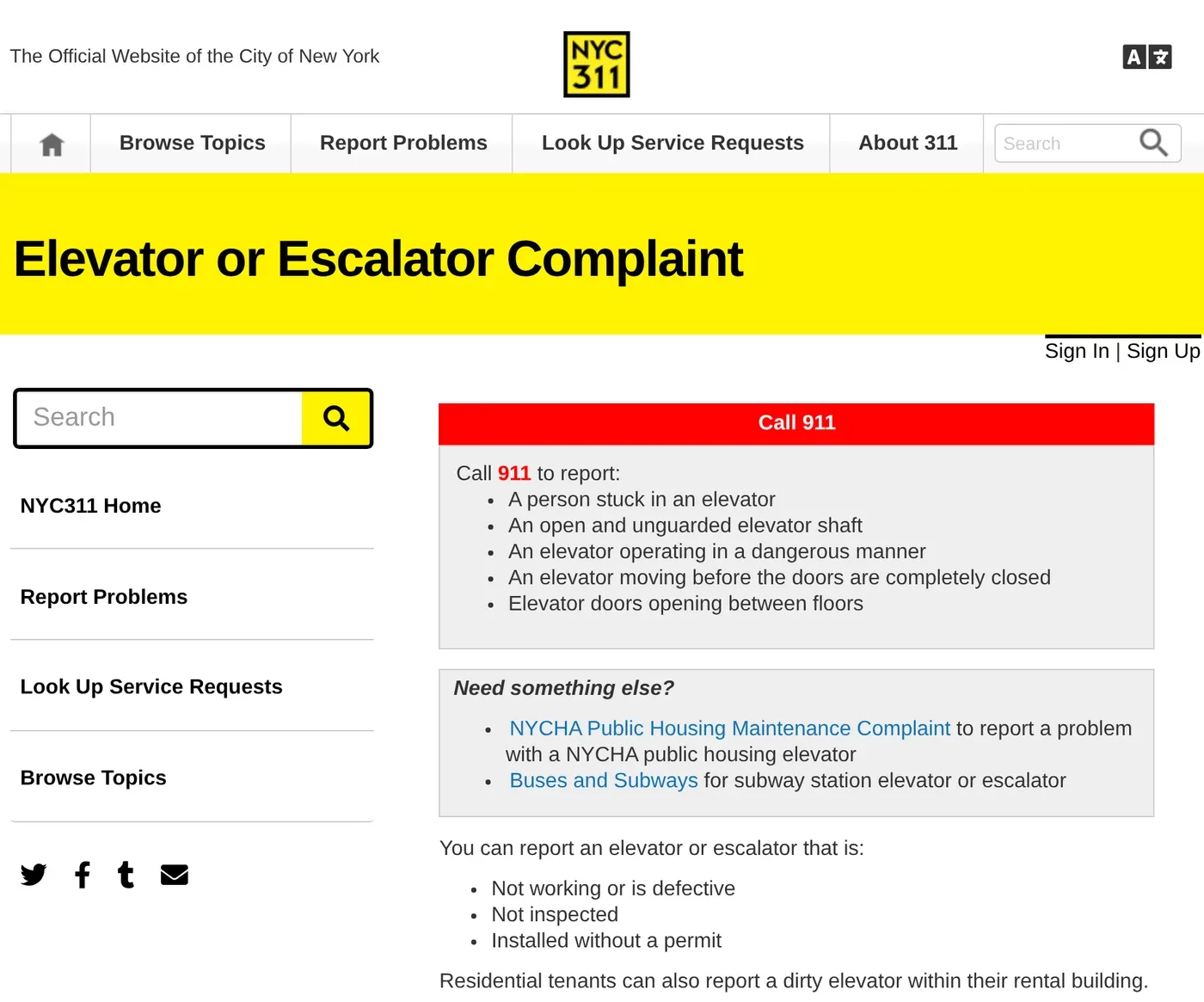
311’s own page sends entrapments and dangerous operation to 911. Everything else, including a car that’s simply not working, goes through 311.
Source: NYC311, Elevator or Escalator Complaint. Captured October 21, 2026.If someone is trapped, that’s a different playbook with its own rules: call 911 and your elevator company, and never let anyone pry the doors. For the breakdown itself, see how we handle elevator repair calls.
Print this list and keep it with the super. Tick items as you go; progress saves in this browser.
Elevator outage checklist
0 of 8 done
From "NYC Elevator Out of Service: How Long Can a Landlord Leave It Broken?" by Faraday Elevator, faraday-elevator.com/blog/nyc-elevator-out-of-service-how-long.html. General information, not legal advice.
How Faraday can help
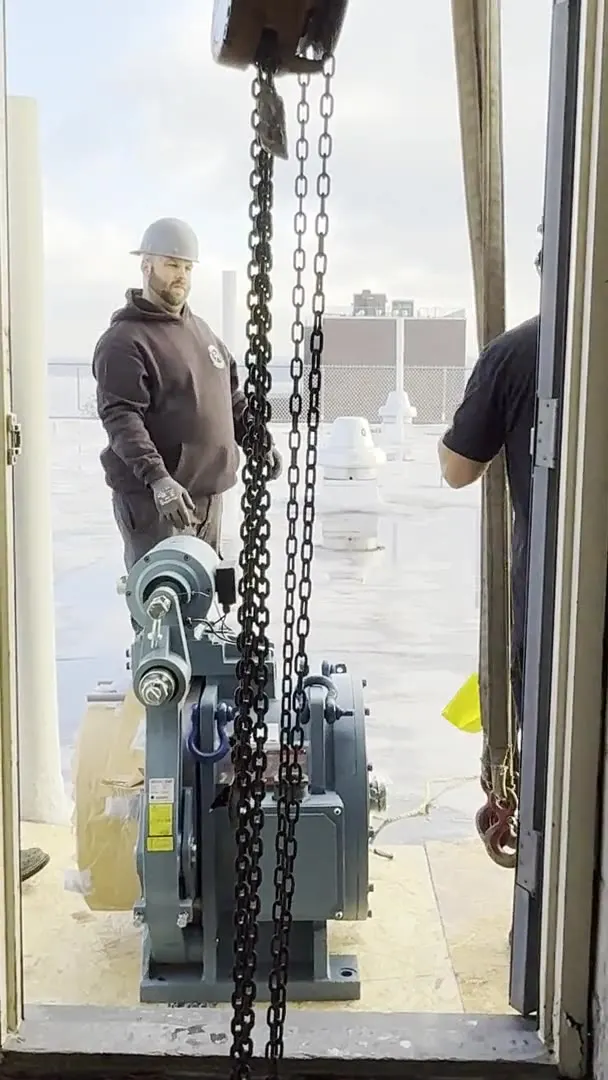
Faraday crew guiding a machine into place on a rooftop.
Source: Faraday Elevator job site photoFaraday Elevator is a licensed NYC and NJ elevator company with Local Union No. 3 IBEW mechanics.
When a car goes down we handle the repair, put the parts and timeline in writing, and keep the building informed. If the same car keeps failing, it may be time to talk about a better maintenance program or a modernization of the existing equipment.
Wondering whether your current contract covers callbacks and parts? Our free contract review will tell you. And if a violation is already on the books, see our guide to looking up and clearing NYC elevator violations.
Frequently asked questions
How long can an elevator be out of service in NYC?
There is no single repair deadline for every outage, but when all elevators in a building or building section are out, DOB treats it as a condition dangerous to life and safety under 1 RCNY §103-19 and can take daily enforcement action after it issues an immediately hazardous violation. If that outage goes past 14 days, the owner must provide alternative accommodations for tenants and give DOB proof of a practical difficulty plus a restoration schedule.
What counts as an alternative accommodation?
The rule lists four examples: a temporary vertical transportation device in the building, relocating tenants to floors where an elevator is not required (people with disabilities must go to an accessible ground-floor space), relocating tenants to a building with elevator service, or reimbursing hotel or other lodging costs.
Do landlords have to notify tenants before elevator work?
Yes, in R-1 and R-2 buildings. Under Administrative Code §28-304.10 (Local Law 47 of 2015), owners give at least 10 business days' notice before alteration work, except emergency repairs, minor alterations and ordinary repairs. When all elevators serving a building or section will be out for two hours or more, notice goes up at least 24 hours ahead. Notices must be in English and Spanish and give the type of work and the start and end dates.
What happens if the owner doesn't fix the elevator?
When an owner fails to restore service as ordered by DOB and the compliance period runs out, DOB refers the condition to HPD. HPD can hire a contractor to make the repair, bill the property through the Department of Finance, file a tax lien if the bill goes unpaid, and seek an order in Housing Court.
Who should tenants call about a broken elevator?
Call 911 if someone is stuck, an elevator shaft is open and unguarded, a car moves before its doors are fully closed, or the doors open between floors. For an elevator that is not working or is defective, file a complaint through 311.
Sources
- 1.1 RCNY §103-19, Elevator and escalator violations constituting a condition dangerous to human life and safety (NYC DOB)
- 2.NYC DOB, Notice of adoption for Chapter 11 elevator rules, including new §103-19 (effective June 11, 2026)
- 3.NYC Local Law 47 of 2015, Administrative Code §28-304.10 occupant notification for elevator work
- 4.NYC DOB, Elevator Issues (tenant guide)
- 5.NYC HPD, Elevators
- 6.NYC HPD and DOB, Report on the Implementation of Local Law 101 of 2015, FY25
- 7.NYC311, Elevator or Escalator Complaint
- 8.NYC Open Data, 311 Service Requests from 2020 to Present
Rules were checked against the sources above on October 26, 2026. 311 figures come from NYC Open Data as of October 25, 2026. This guide is general information, not legal advice. DOB and HPD set and can change these requirements, so confirm current rules with them before you act.
This is not legal advice. Please speak with an attorney to discuss your specific situation and how the law applies to you.