
NYC Compliance Guide
NYC Cat 1: What Happens If I Miss a Category 1 Inspection?
Miss your NYC Cat 1 elevator test and DOB can fine you up to $3,000 per elevator. See the December 31 deadline, filing window, and how to check your status.
Every elevator in New York City needs a Category 1 test, often called a Cat 1 inspection, each calendar year. For 2026, the last day to perform it is December 31, which is the hard cutoff.
When we pulled DOB’s public data on October 20, 2026, about one in three active elevators in the city didn’t show a 2026 Cat 1 report yet. If one of them is yours, here’s what the deadlines actually are, what DOB charges when they’re missed, and how to check your building in a few minutes.
- Last day to test
- Dec 31
- Active NYC elevators
- 81,387
- 2026 Cat 1 on file
- 53,830
- Not on file yet
- 27,557
Elevator counts: NYC Open Data, DOB NOW Elevator Safety Compliance, active elevators, data updated October 19, 2026.
The Cat 1 deadline at a glance
A Cat 1 is the annual no-load safety test. It’s separate from the annual periodic inspection, which is visual. DOB wants both, every year.
The 2026 cycle runs from January 1 through December 31. That comes straight from the rule:
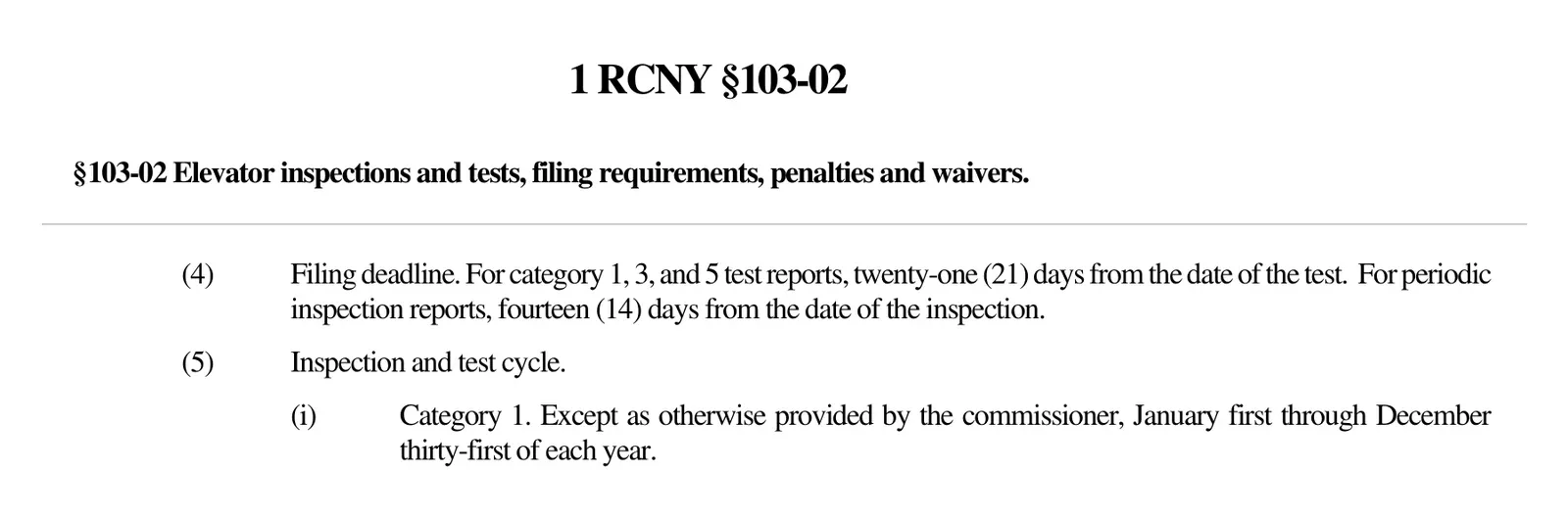
The rule sets two clocks: the calendar year for the test, and 21 days from the test date for the report.
Source: 1 RCNY §103-02 (PDF), NYC Department of Buildings. Captured October 20, 2026.Here is how those clocks line up:
The 2026 calendar Same dates for every building
-
Jan 1, 2026
Cycle opens
The 2026 Cat 1 test can be performed any day from here.
-
Dec 31, 2026
Last day to test
The test itself must happen inside the calendar year.
-
Jan 21, 2027
Filing window closes
DOB stops accepting 2026 Cat 1 reports. Failure to file violations follow.
The clock that starts on test day Counted from the date of your test
-
Day 0
Test day
Approved agency witnesses the test. Note every defect.
-
Day 21
Report due
File the Cat 1 report within 21 days to avoid late fees.
-
Day 90
Defects fixed
Correct defects within 90 days. Hazardous conditions: immediately.
-
Day 104
AOC on file
Affirmation of Correction due 14 days after the fix, or a Failure to Correct violation.
Sources: NYC DOB Elevator Compliance and 1 RCNY §103-02.
Three details catch people out:
- The report has its own deadline. It is due 21 days from the test date, not on December 31. A test on December 30 has a report due January 20.
- The test must be witnessed. Category tests are witnessed by an approved independent agency licensed by DOB, and the owner is responsible for hiring that agency. Our Cat 1 vs. Cat 5 guide explains who does what on test day.
- Spacing matters. DOB rules put the periodic inspection at least three months from any Cat 1 test. If both are still open, plan the order with your agency before you book either one.
Where NYC stood in October
DOB publishes every elevator’s filing status on NYC Open Data. We pulled the numbers on October 20, 2026.
Of 81,387 active elevators, 53,830 show a 2026 Cat 1 report. That left 27,557 without one, and every one of those tests has to happen by December 31.
2026 Cat 1 reports on file, by borough
Active elevators with a 2026 Category 1 report vs. without one yet
- Manhattan 13,370 of 42,484 not yet filed (31%)
- Brooklyn 6,533 of 17,400 not yet filed (38%)
- Queens 3,871 of 11,389 not yet filed (34%)
- Bronx 3,256 of 8,734 not yet filed (37%)
- Staten Island 527 of 1,380 not yet filed (38%)
Citywide: 53,830 of 81,387 active elevators show a 2026 Cat 1 report. 27,557 (34%) do not yet.
Some of those devices are fine: the test is done and the report is still inside its 21-day window. But every test that hasn’t happened yet still has to be done by December 31, and the report filed within 21 days.
2026 Cat 1 reports filed, by month
Count of active elevators whose 2026 Category 1 report was filed in each month
Filings peaked in July at 7,746. Oct shows only October 1 to 16 (714 so far). Dashed outlines for the rest of the year are empty on purpose: those reports have not been filed yet.
What happens if you miss December 31
If no 2026 Cat 1 report is on file when the window closes, DOB issues a failure to file violation. For most multifamily and commercial buildings, that is $3,000 per elevator.
| What happened | 1-family or 2-family home | All other buildingsCo-ops, condos, rentals with 3+ units, commercial, mixed-use |
|---|---|---|
| Cat 1 report filed late (test done on time) | $50 per month | $150 per month |
| Late filing fees stop growing at | $600 per elevator | $1,800 per elevator |
| Cat 1 report never filed (failure to file) | $1,000 per elevator | $3,000 per elevator |
| Defects not corrected and AOC not filed by day 104 | $1,000 per elevator | $3,000 per elevator |
| AOC filed late | $50 per month | $150 per month |
| For comparison: Cat 5 report never filed | $1,000 per elevator | $5,000 per elevator |
Amounts from the NYC DOB Elevator Compliance page and 1 RCNY §103-02, checked October 20, 2026. DOB can change fees; confirm before you rely on them.
A quick example. A 40-unit co-op with two elevators that never files its 2026 Cat 1 faces 2 × $3,000 = $6,000 in penalties. It still needs a current test, because DOB requires a current report on file to clear violations from prior years.
Late is far cheaper than never. If the test happened in 2026 but the report went in after its 21-day deadline, the fee is $150 per month per elevator, capped at $1,800. After January 21, DOB will not accept the 2026 report at all.
Violations do not age out. DOB’s August 2025 notice says they stay on the property until the penalty is paid or waived and a current report is filed. Waivers are limited to specific cases, like a new owner or a removed elevator.
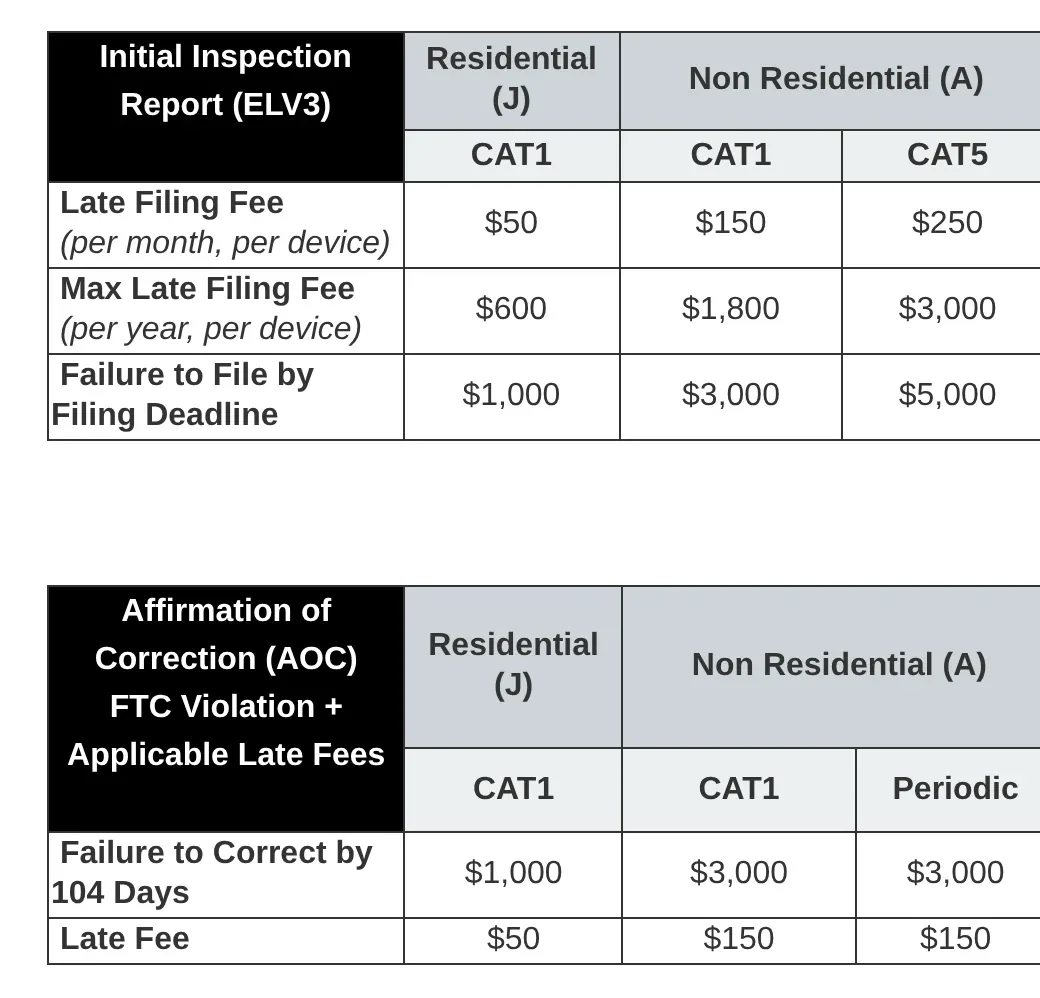
DOB’s own fee tables. The lower “Residential (J)” amounts match the rule’s penalties for buildings with one or two residential units. The “Non Residential (A)” amounts apply to all other buildings.
Source: NYC Department of Buildings, Elevator Compliance page. Captured October 20, 2026.This isn’t rare. DOB issues thousands of these every cycle:
Failure to file Cat 1 violations, by test cycle
DOB violations for elevators with no Cat 1 report on file, 2018 to 2025 cycles
- 2018 8,012
- 2019 6,642
- 2020 8,978
- 2021 6,669
- 2022 7,534
- 2023 6,874
- 2024 5,428
- 2025 4,712
That is 54,849 failure to file Cat 1 violations across 8 cycles. For most buildings each one carries a $3,000 penalty per elevator.
Defects: the deadline after the deadline
If a Cat 1 finds defects, you’re not done until they’re fixed and an Affirmation of Correction (AOC) is filed.
- Fix defects within 90 days of the test. Hazardous conditions and firefighter service defects must be fixed immediately.
- File the AOC within 14 days of the fix.
- Miss day 104 and DOB issues a Failure to Correct violation: $3,000 per elevator for most buildings.
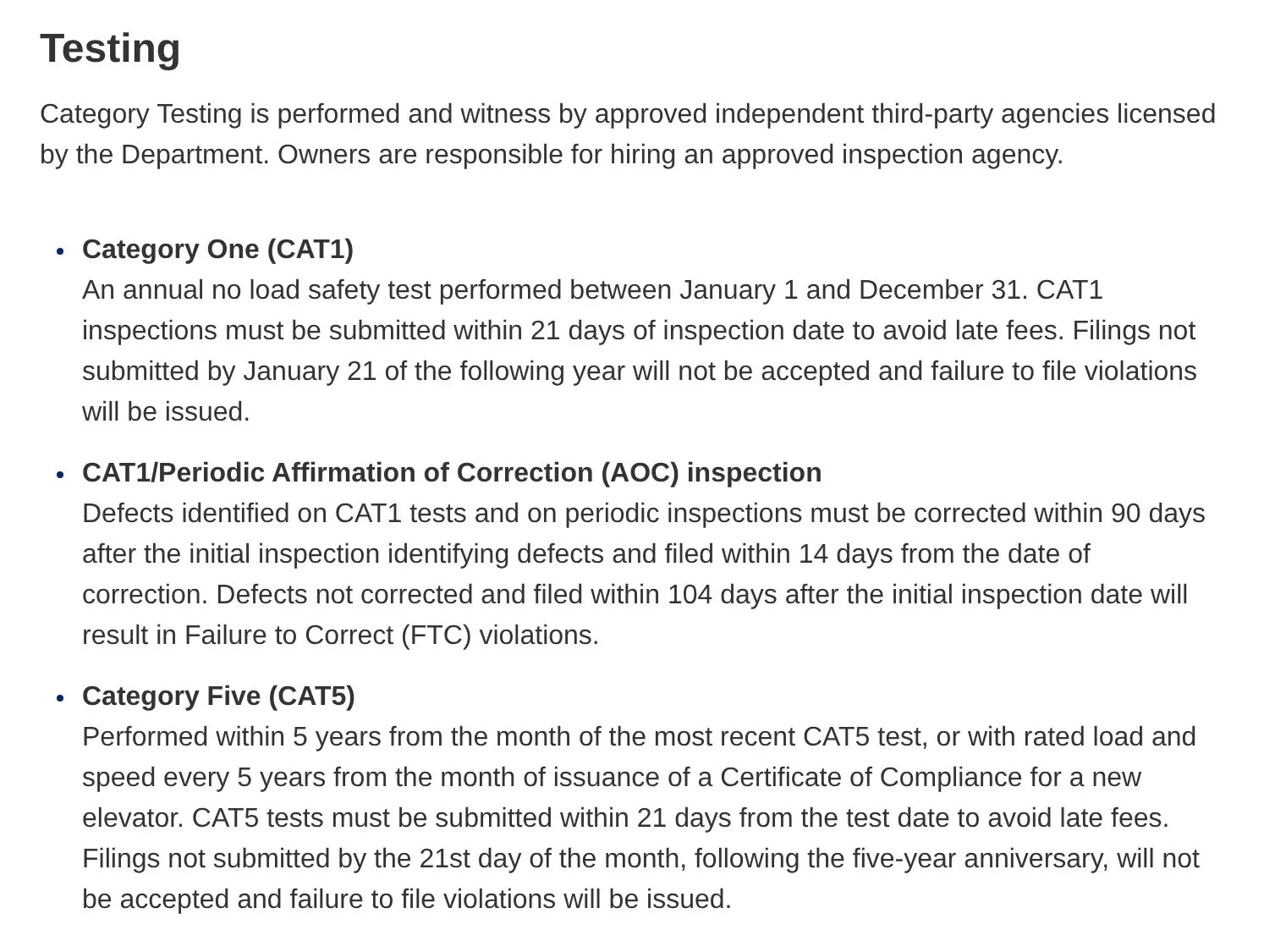
DOB’s summary of the Cat 1, AOC and Cat 5 timelines.
Source: NYC Department of Buildings, Elevator Compliance page. Captured October 20, 2026.This is where more buildings slip. For the 2024 cycle, DOB issued 10,042 failure to correct Cat 1 violations, almost double the 5,428 failure to file Cat 1 violations that cycle.
A late test also pushes the repair deadline into next year. Test on December 15, and corrections are due by mid March, with the AOC due by the end of March.
How to check your building’s Cat 1 status
You don’t need a login for either method below. Have your building’s address or BIN (Building Identification Number) handy. You can find the BIN by looking up your address in DOB’s Building Information Search (BIS). Use BIS only for the BIN: it does not include filings made in DOB NOW.
Option 1: NYC Open Data (every elevator in the building at once)
- Open the DOB NOW Elevator Safety Compliance dataset and select the Data tab.
- Add a filter: BIN is your BIN.
- For each row with Device Status Active, check that CAT1 Report Year says 2026.

Example: the three elevators at 185 Madison Avenue, the building that houses our New York office. All three show a 2026 Cat 1.
Source: NYC Open Data, DOB NOW Elevator Safety Compliance. Captured October 20, 2026.Option 2: DOB NOW Public Portal (one elevator in detail)
- Go to the DOB NOW Public Portal and click Device.
- Set Device Type to Elevator, enter the device number from Option 1, and search.
- Open SAFETY: Compliance Filings. Look for a 1 Year Test / Category 1 row dated 2026, then check the Affirmation of Correction (ELV29) tab for open defects.
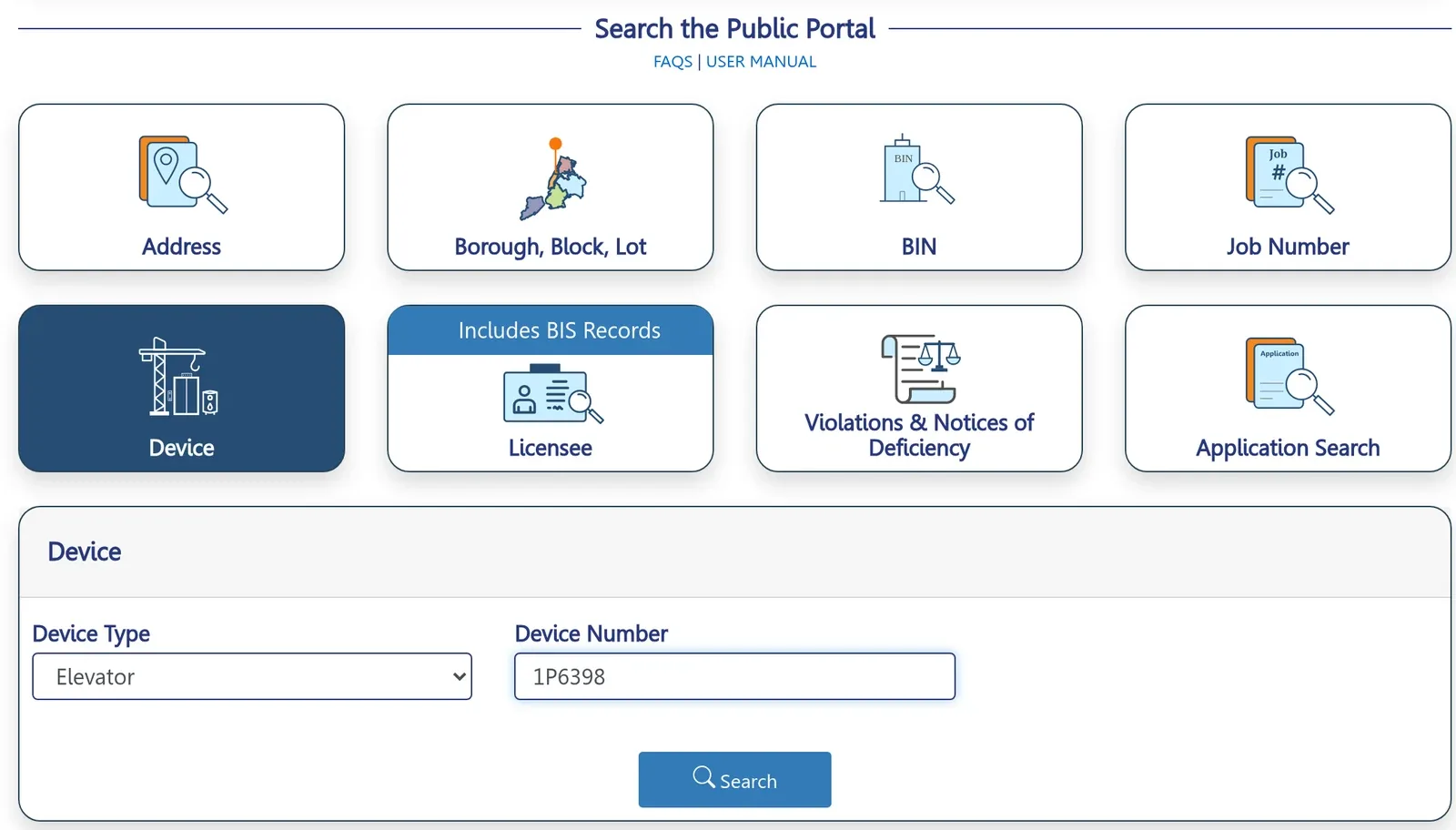
Step 2: search by device number.
Source: DOB NOW Public Portal, NYC Department of Buildings. Captured October 20, 2026.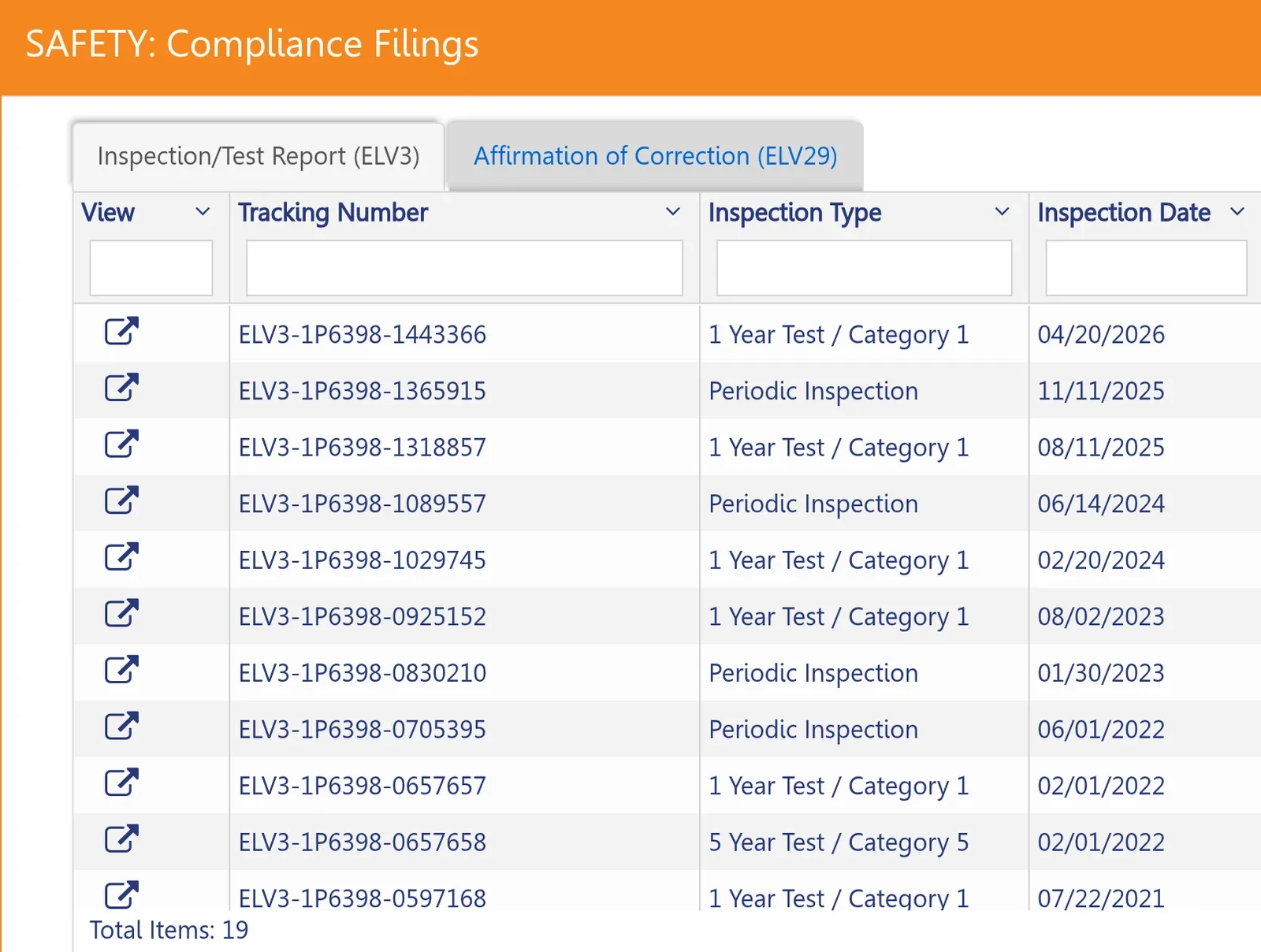
Step 3: the filing history. The top row is this elevator’s 2026 Cat 1, dated April 20, 2026.
Source: DOB NOW Public Portal, NYC Department of Buildings. Captured October 20, 2026.If the two sources ever disagree, go with DOB NOW. Open Data is a published copy of DOB NOW records, refreshed daily.
What to do this week
Work through this list for each building. Tick items as you go; your progress saves in this browser, and you can print a clean copy for the board or your super.
2026 Cat 1 checklist
0 of 8 done
From "NYC Cat 1: What Happens If I Miss a Category 1 Inspection?" by Faraday Elevator, faraday-elevator.com/blog/nyc-cat-1-elevator-test-deadline.html. General information, not legal advice.
How Faraday can help
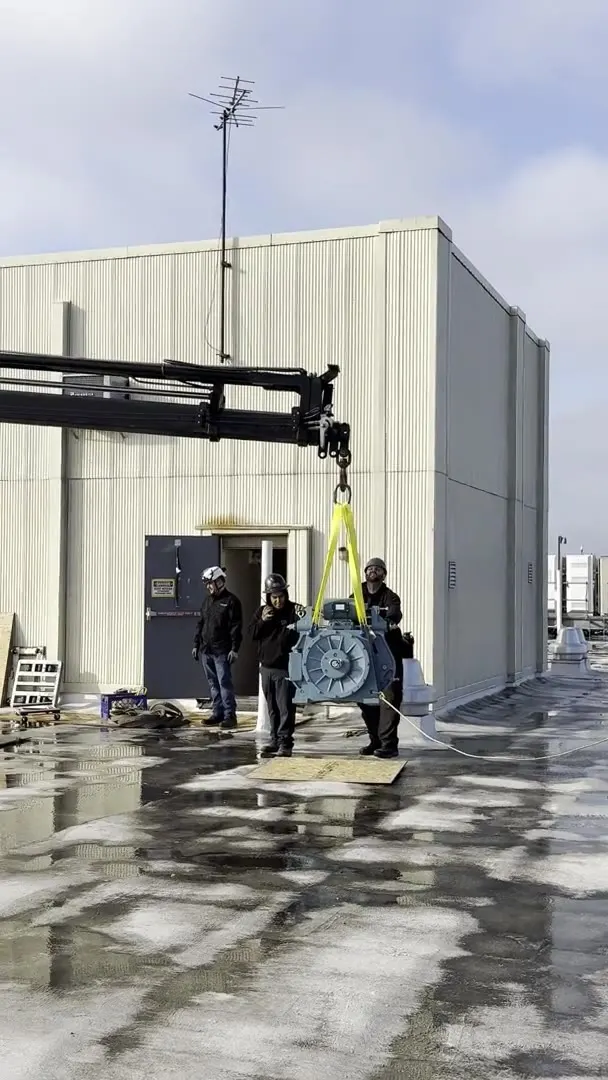
Faraday crew staging an elevator machine for a crane lift on a rooftop.
Source: Faraday Elevator job site photoFaraday Elevator is a licensed NYC and NJ elevator company with Local Union No. 3 IBEW mechanics.
We perform Category 1 and Category 5 testing, coordinate with the witnessing agency, and handle the repairs a test turns up, so defects get closed out before day 104.
Not sure your maintenance contract covers testing? Our free contract review will tell you.
Frequently asked questions
When is the NYC Cat 1 deadline for 2026?
The test must be performed between January 1 and December 31, 2026. The report is due within 21 days of the test date, and DOB will not accept a 2026 Cat 1 filing after January 21, 2027.
What is the fine for missing a Cat 1 test in NYC?
If no report is filed, the penalty is $3,000 per elevator for co-ops, condos, rentals with three or more units, and commercial or mixed-use buildings, and $1,000 per elevator for one-family or two-family homes. If the test was done on time but the report is filed late, the fee is $150 per month per elevator, up to $1,800 ($50 per month, up to $600, for one-family or two-family homes).
If we test on December 30, are we late?
No. The test falls inside the 2026 cycle. The report is due 21 days after the test, which is January 20, 2027, one day before DOB stops accepting 2026 filings.
What happens if the Cat 1 test finds defects?
Defects must be corrected within 90 days of the test, and hazardous conditions and firefighter service defects must be corrected immediately. An Affirmation of Correction is due within 14 days of the fix. If defects are not corrected and filed within 104 days, DOB issues a Failure to Correct violation: $3,000 per elevator for most buildings and $1,000 for one-family or two-family homes.
Can DOB waive a Cat 1 penalty?
Only in limited cases listed in 1 RCNY §103-02, such as a new owner who bought the building after the penalty was incurred, an elevator removed or dismantled under a DOB permit, work in progress on a replacement elevator, or a building that was demolished or ordered sealed or vacated. Waiver requests are filed in DOB NOW: Safety and carry a fee.
Is the Cat 1 test the same as the annual periodic inspection?
No. DOB requires both every year. The periodic inspection is a visual inspection by an approved agency that cannot be affiliated with your maintenance company. The Cat 1 is a no-load safety test. DOB rules require the two to be at least three months apart.
Sources
- 1.NYC Department of Buildings, Elevator Compliance
- 2.1 RCNY §103-02, Elevator inspections and tests, filing requirements, penalties and waivers
- 3.NYC DOB Industry Notice, August 25, 2025: Violations for Failure to File and Failure to File Affirmation of Correction
- 4.NYC Open Data, DOB NOW Elevator Safety Compliance
- 5.NYC Open Data, DOB Safety Violations
- 6.DOB NOW Public Portal
- 7.NYC Local Law 47 of 2015 (occupant notice for elevator outages)
All rules and fees were checked against the sources above on October 20, 2026. Data figures come from NYC Open Data as of October 19, 2026. This guide is general information, not legal advice. DOB sets and can change these requirements, so confirm current rules with DOB before you act.
This is not legal advice. Please speak with an attorney to discuss your specific situation and how the law applies to you.