
Modernization Guide
NYC Elevator Modernization: How Much Does It Cost and How Long Does It Take?
What NYC building owners declare to DOB for elevator modernizations, how long permits take to sign off, how long a car is out, and the 2027 brake deadline.
The elevator company’s mechanic has been saying it for two years: the controller is obsolete, parts are coming off other jobs, and the next big failure is going to take the car out for weeks. Now it’s on the agenda for the board meeting, and the first two questions anyone asks are how much and how long.
Nobody can give you a real number without looking at the equipment. But you don’t have to walk in blind either. Every modernization in New York City is filed with DOB, and the filings are public. We pulled them, and here’s what they show, plus the deadline on January 1, 2027 that’s pushing a lot of buildings to make this call now.
- Median declared cost per filing
- $260k
- Median days, permit to sign off
- 239
- Modernization filings, 2025
- 781
- Brake upgrade deadline
- Jan 1, 2027
Filings: NYC Open Data, DOB NOW: Build Elevator Permit Applications, new elevator alteration filings whose description mentions modernization, data updated October 21, 2026. Deadline: DOB Industry Notice, July 29, 2026.
What a modernization actually is
A modernization replaces the parts of an existing elevator that wear out or go obsolete while keeping what’s still good, usually the hoistway, rails and often the cab shell. It’s a different job from installing a brand new elevator where there wasn’t one, and this guide is only about the existing kind.
Scope varies a lot. A light job might be a new controller and fixtures. A full job can include the controller, the hoist machine or hydraulic power unit, door operators and equipment, wiring, the signal fixtures, and code items the work triggers. Cab interiors are often bid separately. That range is the main reason modernization prices are all over the map.
Is it a big repair or a modernization?
We get this question a lot, usually right after a quote lands that’s bigger than anyone expected. The two get mixed up all the time, and they shouldn’t, because they’re different jobs with different paperwork, different downtime and very different price tags.
A repair fixes the thing that broke. One part failed, and we fix it or replace it so the elevator runs the way it was designed to run. A motor rewind, new hoist ropes, a door operator, a controller board, a hydraulic pump. Some of those are big jobs. But when we’re done, you still have the same elevator, the same age, with one less problem.
A modernization replaces the systems. Instead of chasing one part at a time, we replace or upgrade the major systems: the controller, the hoist machine, the door equipment, the fixtures and wiring, and on a hydraulic car, often the power unit and the cylinder. The goal is an elevator that meets current code and is set up for decades of service, not just until the next part fails.
| Larger repair | Modernization | |
|---|---|---|
| What it does | Fixes or replaces one failed part so the existing system runs as designed | Replaces or upgrades the major systems to bring the car to current code and extend its life for decades |
| Typical work | Motor rewind, hoist ropes, a door operator, a controller board, a hydraulic pump | Controller, hoist machine, door equipment, fixtures and wiring; on hydraulics, often the power unit and cylinder |
| DOB permit | May need a DOB NOW: Build permit depending on the part and the scope. Ask your elevator company to confirm before work starts. | Yes. Filed in DOB NOW: Build as an alteration, then inspected, tested and signed off |
| Car out of service | Typically days, longer if a part has to be made or shipped | Roughly 8 to 16 weeks per car, per Habitat Magazine (2019), inside a permit that ran a median 239 days to sign off |
| Cost | Typically a fraction of a modernization, priced by the part and the labor | Median declared cost of $260k per DOB filing, 2021 to 2025 (declared estimates, not quotes) |
| What you have after | The same equipment, one fixed problem | New major equipment and the code work that came with it |
Modernization figures: NYC Open Data, DOB NOW: Build Elevator Permit Applications, data updated October 21, 2026, and Habitat Magazine, 2019. Repair entries describe typical jobs, not data. Every elevator is different.
Repair isn’t the wrong answer. If the equipment is in decent shape and one part let go, fix it and move on. The trouble starts when a building keeps paying for big repairs on a car that’s worn out everywhere else. That’s money going into equipment that’s coming out anyway.
Signs you need a modernization, not another repair
0 of 6 done
From Faraday Elevator, faraday-elevator.com/blog/nyc-elevator-modernization-cost-timeline.html. General information, not legal advice.
What NYC buildings are declaring to DOB
When a modernization is filed in DOB NOW: Build, the applicant declares an estimated cost. Those numbers aren’t contract prices, and some filings cover more than one car. They’re still the best public reference point we know of, because they’re real NYC jobs.
| Filings, 2021 to 2025 | Declared estimated cost |
|---|---|
| All elevator alteration filings mentioning modernization (n = 3,407) | Median $260k |
| Middle half of those filings | $150k to $469k |
| Filings whose description also mentions hydraulic (n = 161) | Median $190k |
Source: NYC Open Data, DOB NOW: Build Elevator Permit Applications, filing type New Filing, device type Elevator, work type Alteration/Replacement, description contains "moderniz", data updated October 21, 2026. Declared estimates are made at filing, are per filing rather than per car, and are not quotes.
Treat that as a sanity check, not a budget. Your number depends on what’s actually in the scope. These are the things that move it most:
- How many cars, and how many stops. More floors means more door equipment and fixtures.
- Traction or hydraulic. They’re different machines with different parts lists, which shows up in the hydraulic median above.
- What gets replaced. Controller only, or controller plus machine, doors and wiring.
- What the work triggers. An alteration can pull in code upgrades that a repair wouldn’t.
- The schedule. Habitat Magazine reported in 2019 that an expedited 60 hour week schedule added about $7,500 to $10,000 a week, per an elevator consultant it interviewed. That’s a 2019 third party figure, but the tradeoff is the same today.
How long it takes
There are two clocks here, and people mix them up. One is the life of the permit. The other is how long the car is actually out of service.
| Stage (DOB NOW dates) | Median | Middle half |
|---|---|---|
| Filing to permit (n = 3,397) | 5 days | 2 to 13 days |
| Permit to sign off (n = 2,893) | 239 days | 147 to 394 days |
Source: NYC Open Data, DOB NOW: Build Elevator Permit Applications, same filter as above. Sign-off figures only include filings that have been signed off.
Permits come fast. The permit to sign off stretch is long because it covers everything: waiting on equipment, the work itself, testing, and DOB’s sign-off. The out of service window sits inside it. Habitat Magazine’s 2019 piece put that at roughly 8 to 16 weeks for a modernization, and quoted an elevator company president saying it can take six months from choosing a vendor to finishing if things go smoothly, and up to a year if they don’t.
Here’s how the pieces usually fall:
From survey to sign-off Order of events; durations vary by job
-
Scope
Survey and spec
Survey the equipment and write one scope every bidder prices.
-
Filing
DOB NOW: Build
A licensed elevator agency director or design professional files. Median 5 days to permit.
-
Notice
10 business days
Post notice in English and Spanish before work starts. Post the permit.
-
Work
Car out of service
Equipment is removed, installed and adjusted. Plan resident support for this stretch.
-
Sign off
Test and close
Inspection and test, then the job is signed off in DOB NOW.
Sources: DOB elevator owner page, Local Law 47 of 2015, DOB NOW filings.
One more thing if it’s a single elevator building. A modernization is planned work, but the rule DOB adopted in June 2026 says that when every elevator in a building is out more than 14 days, the owner has to offer tenants alternative accommodations. Plan for that before the car comes out of service, not after. We cover it in our guide on how long an NYC elevator can be out of service.
The permits and paperwork
DOB’s owner page sums up the rules owners deal with on a modernization:
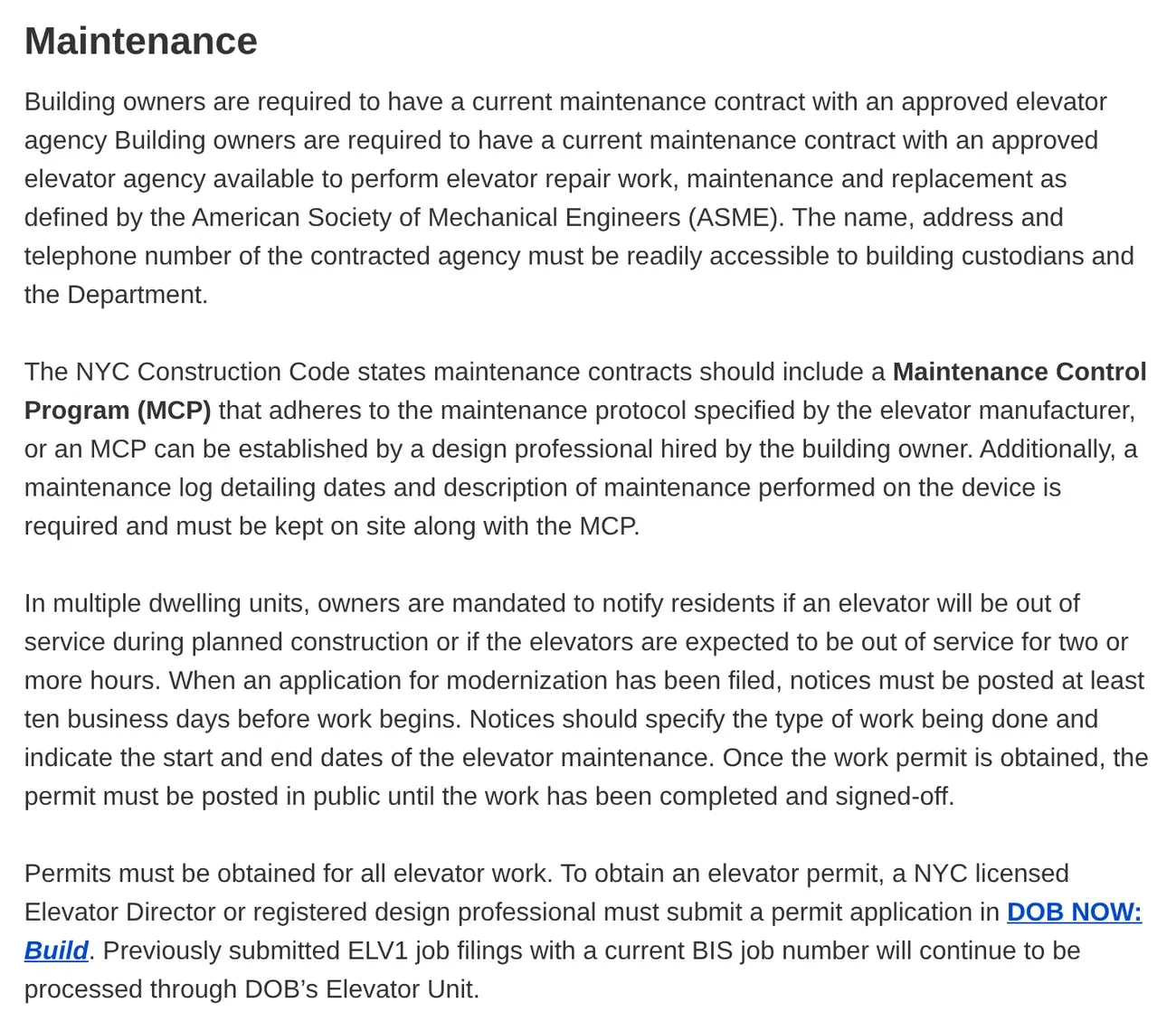
Permits for all elevator work, notice before modernization, and the permit posted until sign-off.
Source: NYC Department of Buildings, Elevators (property owner page). Captured October 21, 2026.In short: a permit for all elevator work, filed in DOB NOW: Build by a licensed elevator agency director or registered design professional. Notice to residents at least ten business days before work begins, saying what’s being done and the start and end dates. And once the permit is issued, it stays posted in public until the work is signed off.
The January 1, 2027 brake deadline
This is the one on a lot of agendas right now. DOB sent its final reminder on July 29, 2026: existing traction elevators with single plunger brakes have to be brought into compliance by January 1, 2027.
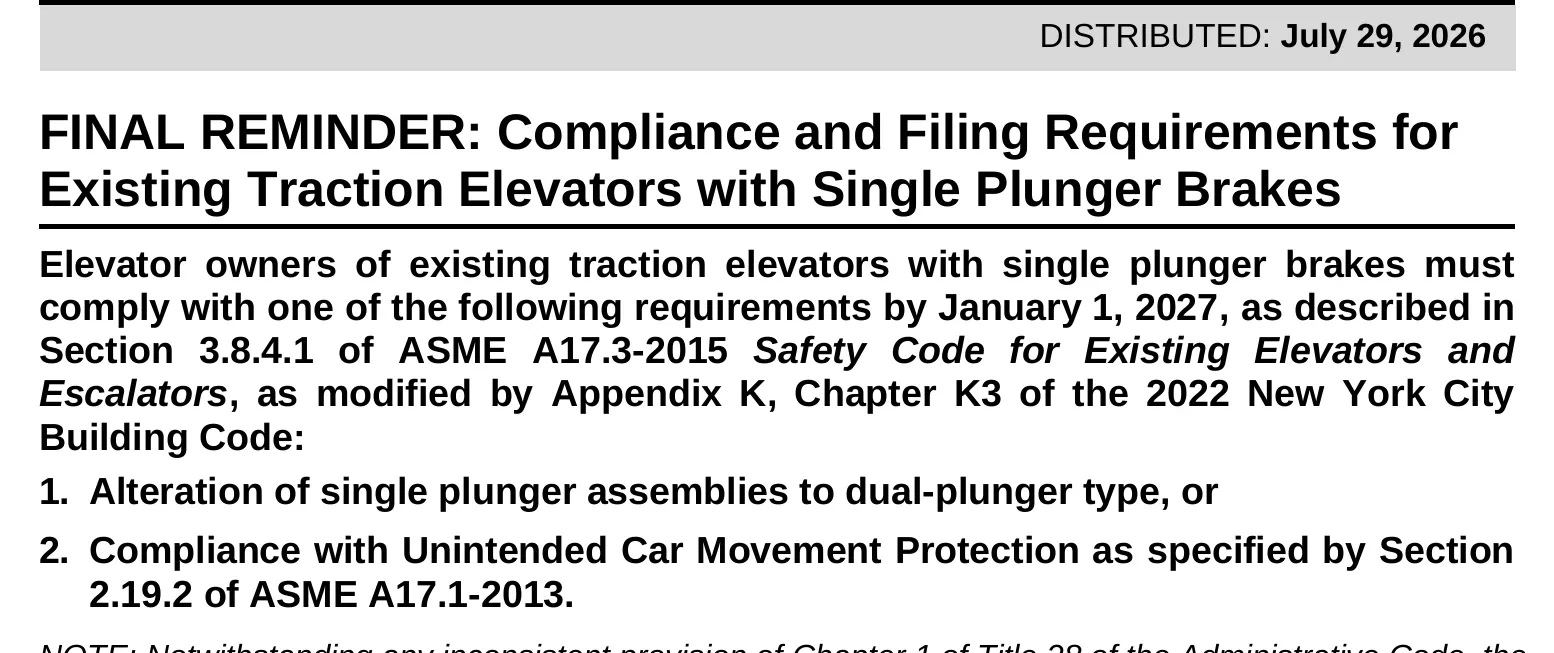
DOB’s final reminder. The requirement comes from ASME A17.3-2015 §3.8.4.1 as modified by Appendix K, Chapter K3 of the 2022 NYC Building Code.
Source: NYC DOB Industry Notice, July 29, 2026 (PDF). Captured October 21, 2026.There are two ways to comply: convert the single plunger brake to a dual plunger type, or meet the Unintended Car Movement Protection requirements of ASME A17.1-2013 §2.19.2. Either way, the notice says:
- The work needs a permit, filed in DOB NOW: Build using the PPN process.
- It must be filed by a DOB approved Elevator Agency Director or Co-Director, not a design professional.
- Design drawings and manufacturer or design professional approval letters stay in the machine room, available to DOB on request.
- The agency notifies DOB at least 48 hours before the inspection and test, by email to ElevatorTechnical@buildings.nyc.gov.
If your traction cars are old enough that the brake is only one of several problems, this is a natural point to price the brake work against a broader modernization. Sometimes the brake retrofit alone is the right call. Sometimes it’s money spent on a machine that’s coming out in three years anyway.
How many buildings are doing this
Modernization filings dipped in 2021 and 2023 and have climbed since. 2026 has already passed 2025’s full year total, with almost two months to go.
NYC elevator modernization filings by year
New DOB NOW: Build elevator filings whose description mentions modernization
814 filings so far in 2026, through November 6. The dashed bar is a partial year.
Before the board meeting
Bring answers to these and the meeting goes a lot faster. Tick them off as you go; progress saves in this browser.
Modernization prep checklist
0 of 8 done
From Faraday Elevator, faraday-elevator.com/blog/nyc-elevator-modernization-cost-timeline.html. General information, not legal advice.
How Faraday can help
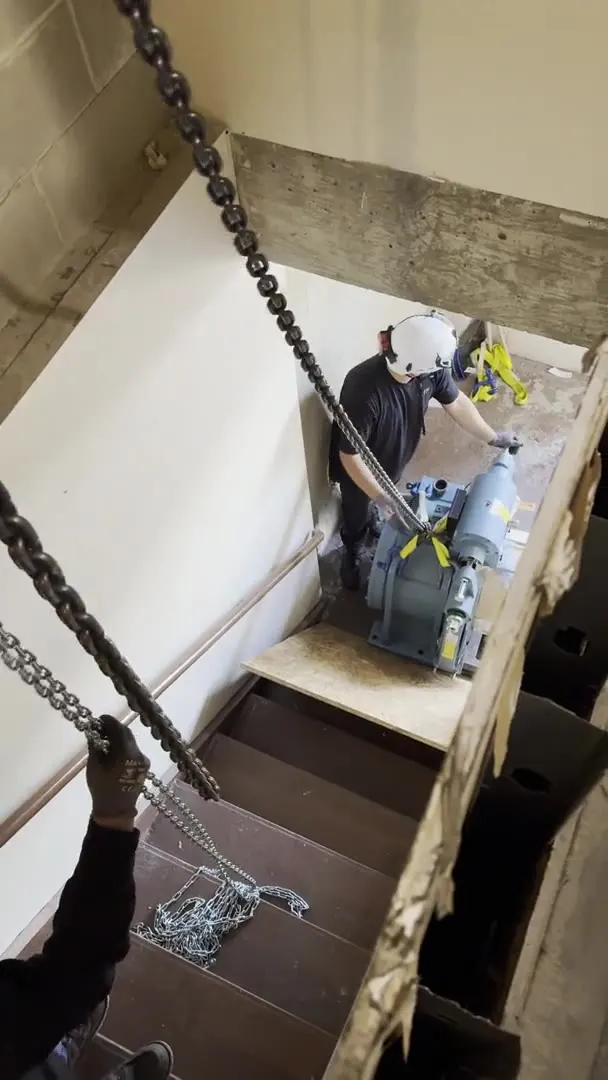
Lowering a motor down a stairwell with chain hoist rigging.
Source: Faraday Elevator job site photoFaraday Elevator is a licensed NYC and NJ elevator company with Local Union No. 3 IBEW mechanics.
We modernize existing elevators: controllers, machines, door equipment and the code work that comes with them, including the 2027 brake requirement. We file with DOB, coordinate the testing, and keep the building in the loop.
After the job, the new equipment needs maintenance that fits it. If you’re also rethinking your current contract, our free contract review is a good place to start.
Frequently asked questions
What's the difference between an elevator repair and a modernization?
A repair fixes or replaces one failed part, like a motor, hoist ropes, a door operator, a controller board or a pump, so the existing elevator runs the way it was designed. A modernization replaces or upgrades the major systems, usually the controller, machine, door equipment and fixtures, and on hydraulics often the power unit and cylinder, to bring the elevator up to current code and give it decades more life.
How much does an elevator modernization cost in NYC?
It depends on scope, the number of cars and the equipment. As a reference point, DOB NOW elevator alteration filings from 2021 through 2025 whose description mentions modernization declared a median estimated cost of $260,000 per filing, with the middle half between $150,000 and about $469,000. Some filings cover more than one car, and declared estimates aren't final contract prices.
How long does an elevator modernization take?
In DOB's data, the median time from permit to sign-off for modernization filings from 2021 through 2025 was 239 days, with the middle half between 147 and 394 days. The time a car is actually out of service is shorter. Habitat Magazine reported 8 to 16 weeks in 2019, and six months to a year from choosing a vendor to finishing.
Do I need a permit to modernize an elevator in NYC?
Yes. DOB requires a permit for all elevator work, filed in DOB NOW: Build by a licensed elevator agency director or registered design professional. Once the permit is issued it must be posted until the work is done and signed off.
Do tenants have to be notified before an elevator modernization?
Yes, in residential R-1 and R-2 buildings. Notice in English and Spanish must go up at least 10 business days before alteration work starts, with the type of work and the start and end dates.
What is the January 1, 2027 elevator brake deadline?
DOB's July 29, 2026 industry notice says existing traction elevators with single plunger brakes must either convert to a dual plunger type or comply with Unintended Car Movement Protection per ASME A17.1-2013 §2.19.2 by January 1, 2027. The work needs a DOB NOW: Build permit filed through the PPN process by an approved elevator agency director.
Sources
- 1.NYC Open Data, DOB NOW: Build Elevator Permit Applications
- 2.NYC DOB Industry Notice, July 29, 2026: Final Reminder, Existing Traction Elevators with Single Plunger Brakes
- 3.NYC Department of Buildings, Elevators (property owner page)
- 4.NYC Local Law 47 of 2015, occupant notification for elevator work
- 5.1 RCNY §103-19, elevator outages beyond 14 days
- 6.Habitat Magazine, "An Elevator Overhaul Is Both Headache and Opportunity" (March 12, 2019)
Rules were checked against the sources above on October 21, 2026. Filing figures come from NYC Open Data as of October 21, 2026 (the filings by year chart as of November 8, 2026), and are declared estimates per filing, not prices or quotes. Habitat Magazine figures are third party reporting from 2019. This guide is general information, not legal or engineering advice. DOB sets and can change these requirements, so confirm current rules with DOB before you act.
This is not legal advice. Please speak with an attorney to discuss your specific situation and how the law applies to you.